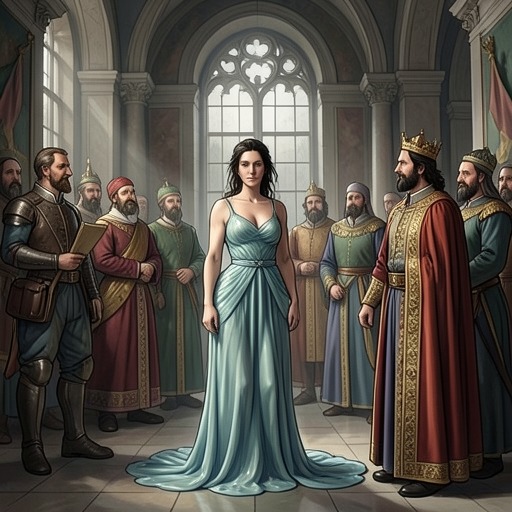
Marriage of Marie-Josèphe and Lucien
The Moon and the SunThe marriage of Marie-Josèphe and Lucien is imposed as a royal punishment, yet its aftermath becomes an affirmation of their love and of Marie-Josèphe’s right to choose her own life. Louis XIV and Pope Innocent control the public terms of the union, but neither title nor ceremony determines what it means to the couple: that meaning is made in private, when Lucien offers to release Marie-Josèphe from life with him and she refuses to treat his loss of status as a reason to leave.
Causes and Royal Terms
The marriage is presented as one of the penalties Louis XIV considers for Marie-Josèphe. Pope Innocent forbids her to compose music and demands her silence; Louis XIV remarks that she might have been very good at music if she had been a man. He then says that she wants a husband and children, and that he had considered forbidding those to her by sending her to a convent. Instead, he announces marriage as his punishment. The arrangement thus joins control of her work to control of her future: marriage is offered not first as a private bond, but as an instrument of royal authority.
That framing makes the wedding’s public exchange especially significant. Yves de la Croix remains silent when Pope Innocent asks who gives the woman. Louis XIV answers for him. The King’s response makes his authority visible at the moment Marie-Josèphe is given in marriage, while leaving her own consent unspoken in the ceremony. The episode does not present the formal act as the couple’s emotional resolution; that comes later, in their conversation alone.
The Ceremony and Its Public Authority
Before the exchange, Yves unrolls a piece of vellum and holds it to a candle flame. It smokes and contorts as it burns, and he drops the ashes into an Aztec dish with blistered fingers. The passage does not explain the vellum’s precise significance, but its destruction precedes the marriage ceremony and gives the scene a concrete act of erasure amid the proceedings.
Pope Innocent presides over the marriage, and Louis XIV supplies the answer to the question of who gives Marie-Josèphe. Her own inward response sharply distinguishes official honor from personal attachment: she regards herself as married by the Prince of Rome and given in marriage by the King of France and Navarre, but finds the honors themselves unimportant beside the fact that she loves Lucien and believes he loves her. The contrast is central to the event. Public powers can authorize and stage the marriage; they cannot make its emotional value for her.
Private Negotiation and Mutual Choice
After the ceremony, Marie-Josèphe packs her few belongings while Lucien sits by a window, absently stroking the cat. He tells her that she may live apart from him. He says she will have her dowry, her liberty, and time for her studies, while he will leave court and never trouble her. His offer is shaped by what he believes he can no longer provide: he is no longer the Count de Chrétien, but only Lucien de Barenton, without title, comfort, resources, or the prospect of children.
Marie-Josèphe answers that she will be his wife in every way. She does not pretend that his losses are immaterial to him; she recognizes that he cares about having nothing to offer. But she rejects the assumption that wealth, status, or children are the measure of what the marriage can contain. She tells him that she would choose a life with him over everything with anyone else, and names liberty, affection, consideration, and love as things they can still share. She can imagine joy in a child with his spirit, but promises not to torment him over it and leaves open the possibility that he may change his mind.
Lucien responds by kissing her palm and her lips, drawing back reluctantly while sharing her anticipation. The exchange changes the force of the marriage. What began as a punishment decreed by Louis XIV becomes a commitment each of them actively accepts: Lucien makes room for her freedom even at the cost of their separation, and Marie-Josèphe chooses him without requiring his former title or fortune. Her refusal is not a denial of his vulnerability; it is an answer to it.
Relationships, Kinship, and Significance
Marie-Josèphe’s insistence on freely chosen bonds has an earlier parallel in her promise to free Odelette. She had told Odelette that she would never be a slave to anyone and that they would be sisters. When Odelette asked why she had waited, Marie-Josèphe acknowledged that she had not previously understood the difference their unequal status made, and had feared that freedom without resources, protection, or family would leave Odelette exposed. That history makes the marriage conversation more than a declaration of affection: Marie-Josèphe understands that formal freedom can be precarious, yet she refuses to let dependency become the definition of love.
Lucien, for his part, has described family belonging in terms broader than biological parentage alone. He honors his father’s wife as his mother and says that he and his brother are acknowledged, legitimate, and cherished. Against that account, his fear that losing his title leaves him with nothing appears as a crisis of position and provision rather than a simple loss of affection. Marie-Josèphe answers by locating the marriage’s value in their treatment of one another, not in the rank bestowed by the court.
The event therefore holds coercion and choice together without confusing them. Louis XIV determines the public terms and calls the match a punishment; Marie-Josèphe and Lucien privately redefine its meaning. The conclusion offers no return to Lucien’s former standing and no promise that every difficulty has been settled. Instead, it ends on a smaller, more intimate assurance: stripped of courtly rewards, the couple still choose a shared life.